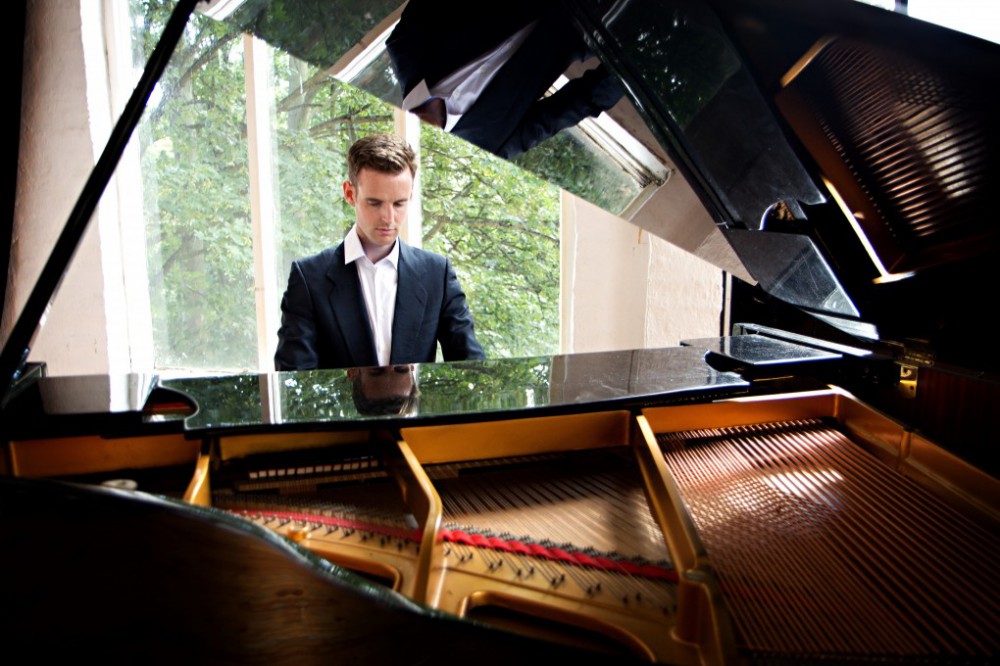
An interview with Frances Wilson (@crosseyedpianist):
John’s recent performance, with fellow musicians from Aurora Orchestra, of Mozart’s Concerto No. 18 (K.456, arr. Hummel for chamber ensemble) received striking reviews in The Times, the Financial Times and The Telegraph:
‘John Reid proudly leant back at his piano as if riding a circus pony decked with plumes. And so he was, given the concerto’s decorative charms and invention. Delightful music-making, this.’
Geoff Brown in The Times (6th February 2019)
‘Johann Hummel’s neat arrangement of Mozart’s Piano Concerto No. 18 in B flat for chamber ensemble showcased some pristine piano playing from John Reid, as well as the impeccable ensemble of which the Aurora is capable.’
Hannah Nepil in the Financial Times (4th February 2019)
‘…it would be easy to gloss over the opening piece of the first concert, the 18th Piano Concerto by a certain male composer named Mozart. But that would be a mistake, because the performance of the piece, in an arrangement for piano, flute, violin and cello, was a joy. To see pianist John Reid change in the blink of an eye from tactful harmonic support for the trio to being a gracefully assertive soloist, and back again, was the most musically subtle part of the evening.’
Ivan Hewitt in The Telegraph (3rd February 2019)
Some further reviews:
‘John Reid…whose pianism is astoundingly vivid…’
David Nice in The Arts Desk
http://www.theartsdesk.com/opera/turn-screw-aurora-orchestra-lso-st-lukes
‘The concert had begun with Mahler’s only real piece of chamber music, the single movement that survives of his early Piano Quartet, and performed here with weight and purpose. It was played as a prelude to the other main work on the programme, Mozart’s Piano Concerto no. 11 in F major K413, also given in a chamber version, though this time one made by its composer himself. Rather than a flashy concerto, it takes on the feeling more of a domestic sextet for piano and strings, not an inappropriate sense for a work more notable for its charm than its showiness. Soloist John Reid, the Aurora’s own pianist, interpreted it as such, allowing for plenty of mutual give and take between the six musicians in a performance full of lyrical appeal and rhythmic fleet-footedness.’
Matthew Rye in http://www.bachtrack.com: https://bachtrack.com/review-mahler-lied-erde-staples-connolly-aurora-kings-place-october-2017
‘Alongside his vivacious accompaniments, pianist John Reid played Kodály’s Dances from Marosszék… He recommended that we listen to Toscanini’s recording of the orchestral version, but after his performance that seemed hardly necessary, for he summoned up a whole wealth of orchestral colour on his own.’
http://bachtrack.com/review-dec-2013-rns-cabaret-sage-gateshead
‘The Brahms songs were made all the more enjoyable by [Diana] Moore’s partner at the piano, John Reid, who played with passion and conviction.‘
http://bachtrack.com/review-celebration-of-kathleen-ferrier
For complete reviews on Bachtrack, see:
http://bachtrack.com/performer/john-reid
‘The two groups of songs were separated by Schumann in similar mood, with three movements from his Waldszenen sympathetically played by pianist John Reid.’
Richard Fairman in the Financial Times, March 2012
http://www.ft.com/cms/s/2/4e52b9a0-6f5d-11e1-9c57-00144feab49a.html#axzz29TigqMEJ
‘You’ve probably never heard much of this music, and you’ll probably enjoy all of it. The Emanuel Ensemble, a young trio comprising a flute, cello and piano, have really put together a smart, adventurous and totally pleasing program here… …this is such an exceptionally fine young ensemble, and such a marvel of a program, that I can’t possibly hold back from the highest recommendation.’
Brian Reinhart in Music Web International, February 2012
http://www.musicweb-international.com/classrev/2012/Feb12/Emanuel_CHRCD023.htm
‘…a highly stimulating programme, impeccably played and recorded.’
Ivan March in Gramophone, October 2011
‘A great story, with John Reid at the piano digging deep into Janáček’s emotive piano writing, and providing faultless continuity and support for the singers.’
Sebastian Scotney in London Jazz Blogspot, September 2011
http://www.londonjazznews.com/2011/09/kings-place-festival-2011-saturday.html
‘Nicholas Mulroy and pianist John Reid delivered [Raymond Yiu’s] Dead Letters with authority and dedicated commitment, as they did with other well-established masterpieces: Britten’s First Canticle and Winter Words (such a wonderful feel for Hardy’s often desolate poetry and Britten’s brittle, apposite piano writing), Tippett’s awesomely difficult The Heart’s Assurance…and songs by Purcell and John Ireland.’
Christopher Morley in The Birmingham Post, July 2010
 John Reid